The Waiting Room Mom

If they only knew
Thoughts from  Waiting Room Mom
So here I am again in yet another doctor’s waiting room.  It’s windowless, with worn carpet and old crinkled magazines from 2012.   It feels like I’ve been living in waiting rooms like this one for years now, ever since we decided that something was wrong with Billy and needed to find out what it was.  

(DENIAL: )

 The doctor has been working with my child for the last 40 minutes, ‘testing’ him, they call it. My husband says that nothing is wrong with him and that I am wasting my time. Maybe he is right? I am getting antsy. I wonder if my child is doing okay, if they’re kind,  if they are not embarrassing him, if they remember to give him a snack because we  watch his blood sugar. I wonder if anything he says reflects badly on me as a parent, are they judging me?

(ANGER:)   

          I remember, with a wince, how I yelled at Billy last night before going to bed, but only because it had been such a long stressful day and instead of getting quieter, Billy was revving  up this engine becoming increasingly more manic and I knew how badly he needed his sleep before meeting the doctor today. I know we get angry with him so often but only because it’s so frustrating!  I hope the doctor won’t draw conclusions based on how Billy looks today, he is more tired than usual, maybe he is getting sick.  

(DEPRESSION:)

            Wow, it’s been such a stressful winter already! I’m so glad vacation is over, Billy couldn’t handle the lack of structure and our house was a wreck. The stress of finding activities that Billy could cope with (not too much overstimulation, maybe some physical activity, keep him involved, forget about being invited over for a play date, that wasn’t gonna happen, keep him off of video games for at least an hour or two a day, whining, tantrums all from being bored and feeling shut in) and now back to the daily grind of school in a overcrowded class with a teacher that I know hates my kid even though she won’t admit it. Evenings are the worst because I have to micromanage everything he does, when he lets me. … Homework is a nightmare for both of us; why can’t he put together one sentence in under an hour or bribing, cajoling and enduring his sobbing. The sobbing is the worst. Because I know how much he is suffering from whatever he has, lord knows what it is but that’s what we are here to find out. I hope, whatever it is, they don’t blame me.   I am already so depressed, I couldn’t handle more blame. 

(BARGAINING: )

Or maybe it is my fault, I really try but maybe I wasn’t careful enough when I was pregnant. Or maybe I went back to work too soon. I know I could have done better. Ok I will try. From now on, I will be the perfect mother for Billy. Maybe I will try that new diet for Billy that everyone is talking about.  Or maybe I will try that new Neuronic program in the news.  Please Lord,  let him be ok.

Sound familiar? The stress, the waiting room, the unknowing, the self blame? Welcome to the mind of a parent with atypical children. “Atypical” could include  a child with any type of visible or invisible disability. From a physical handicap to an invisible learning disability, autism or ADHD. Or sometimes a child can be quirky, difficult, different or sickly without any specific diagnosis. That might be even harder. To be a parent with a child with a difference means that you have a difference too.  Denial, anger, depression, bargaining, these are all normal parental reactions to working through your feelings as you parent a special needs child.  You are not alone.  You are a soldier, a unsung hero, and a leader to your family.  Please remember to be kind to yourself.  And…..no one is judging you, at least no one who understands.

What To Do When You’re At the End of Your Rope

by Rita Eichenstein, Ph.D. Reprinted from NY Metro Magazine November 21, 2013

As parents, we all have meltdowns now and then. Dr. Rita Eichenstein suggests key ways to deal with stress and frustration that will help you avoid the “end of the rope” and help you and your family feel happier.

5857078_s   Parents of kids with special needs don’t often think about how to take care of themselves. Instead, they’re constantly planning: If I can just get my kid bathed, fed, and in bed, I’ll be okay…. If I can just get through the parent-teacher meeting…. If I can just get my kid to the tutor… This single-minded focus on their child’s needs is understandable, but they don’t take into account how the stress wears on them. Then suddenly they’re shouting at their spouse, yanking their howling child by the arm, or sitting on the bathroom floor weeping. They are at the end of their rope, and it is a sad and scary place to be.

The best way to deal with being at the end of your rope is not to get there in the first place—more on that later. For now, here are two strategies that will help you calm down and refocuswhen you feel yourself nearing the edge.

1. Call for backup. They say it takes a village to raise a child. With a child who has special needs, it takes an army. Have a code word you can use with your partner that automatically buys you 15 minutes of alone time to cool down. If you’re a single parent, have a close neighbor or two agree to take your child for 15 minutes. Everyone needs a backup buddy—if you don’t have one, now is the time to compile your designated buddy list.

2. Use the S.T.O.P. technique. Elisha Goldstein, Ph.D., author of The Now Effect, popularized this technique of mindful awareness. I’ve found that it helps overwrought parents pause their spiraling behavior and reset it.

Stop what you are doing or about to do, and just take a moment to breathe and reflect.

Take a deep breath. Breathe in and out; use your breath as an anchor and become mindful of trying to slow it all down.

Observe your body, emotions, and thoughts. Scan your body and notice any sensations. Don’t judge them. Just notice them. Next, how are you feeling emotionally? Frustrated? Irritated? Let it be okay.

Proceed. Ask yourself what is the most important thing to pay attention to right now. Mindfully proceed with a prioritized and calm action.

 How to Avoid the End of the Rope

All parents occasionally lose control of their emotions—that’s normal. The goal, then, is to limit the number of times it happens. That’s tricky, because the very things that make a person resistant to meltdowns are scarce in the lives of parents: nutritious meals, exercise, and enough sleep. Parents tend to see these as luxuries from a bygone era, like those lovely Sunday mornings with the newspaper. Not so—healthy food, exercise, and sleep are absolute necessities. They are the fuel that enables you to be a tolerant and loving parent. Reaching the end of your rope is a psychological reaction to physiological stress. To avoid it, you must give your body what it needs to function better.

Even if your days of working out at the gym are on hold and fine restaurant meals are a distant memory, there are changes you can make that will instantly improve your mood and resilience.

Eat a high-protein breakfast. No sugar-packed smoothies or coffee and a granola bar. The old standard still works best: eggs, whole-wheat toast, fruit such as apple or banana, and bacon or sausage if you’re so inclined.See 4 other quick and balanced breakfast ideas

Notice how caffeine affects you. I’m not telling you to give up coffee, but do notice how it makes you feel. If you’re too caffeinated, it can jettison all your good intentions and push you to a massive emotional overreaction.

Love the body you’re in, but keep it moving. You probably do a good deal of walking every day. You can walk in a tense, hunched-up way, thinking about what you need to do next, or you can be in the moment—swing your arms and breathe in the air, and use it to get in a few moments of exhilarating movement.

See a sleep specialist if your child’s sleep problems are keeping you awake. Specialists can provide personalized plans for infants or even older children.

If your own insomnia is ruining your nights, turn off the screens (computer, cell, TV) an hour before bedtime. Cuddle with your kid or your partner instead. Physical touch (it doesn’t have to be sex) releases the feel-good chemical oxytocin, which will relax you.

Don’t hate yourself for melting down now and then. We’ve all been there! But if you can change the way you deal with your meltdowns and fortify yourself against them, everyone in your family will be happier for it—especially you.


When to Ask For Help

20049107_sTo be a parent is to be the ultimate go-to person for your child. This includes activities such as bandaging hurt fingers and hurt feelings, explaining to your child the ways of the world, preparing him or her for the first day of school.  These are the types of skills we learn on the job as we grow on our way to being the best parent for our children.

But what happens when you have no answers? What happens when your child is either so confounding or so puzzling or so unexpected that you find yourself coming up empty in terms of your understanding, coping skills or knowing what to do?

It may feel like a little bit of failure to have to ask for outside help.  After all, you are the ultimate go-to person, right? Why does your neighbor seem to have it all together but you are strung out each and every day? Asking for outside help may actually feel a little shaming, as if you are coming up short on your parenting quotient (PQ?).   The truth is, asking for help is empowering.  Raising children requires a village but atypical children require an army.  And you are just the perfect person to be the army commander.  So it may be time to start recruiting candidates to join forces with you!

START THE SEARCH

Who are the experts in your community? In previous times, young parents would turn to their parents, friends, or relatives for support and advice. But due to the increasing amount of atypical conditions that children are having these days, your typical go-to resources may not be as helpful as you’d like.

ASK THE INTERNET

Increasingly parents are turning to the internet for immediate advice and guidance.
This is not usually the best idea although probably by now, all parents are googling for information all the time.  A few reasons the internet will neither enlighten or satisfy you:
1. Internet is like the Wild West, there are too many websites and too much conflicting information, chances are you might loose much sleep over someone’s post about their child that actually has nothing to do with what you are going through.  Even trustworthy sites do not reflect their understanding of YOUR child.
2.  Your understanding of what your child is going through can be colored by what you read. Your ideas about what your child is going through might not fully fit a professional description.  For example, many children can look like they have ADD or ADHD because others issues are impacting them.
3. Commercial aspects of many websites can be long on description and glossy pictures but short on scientific evidence and factual results. Buyer beware! Do not fall for the one treatment cures all approach to your child.  To date, there is no one treatment that legitimately can treat autism, learning disabilities, ADHD, processing disorders, sensory disorders and mood disorders.

START WITH THE FACTS AND ASK THE QUESTIONS
What do you want? Are you looking for information, treatment or parent support? Maybe you are not sure? One thing is for sure, when a parent asks for help, chances are they have worn out all their avenues of coping and their children are continuing to be mysteries.

DR RITA RECOMMENDS:

Start with your pediatrician and ask for a referral to a specialist that will see your child, there are quite a lot of specialists to choose from.  Be sure to choose a specialist that works with your child’s age group.  For example, very young children (under 5) should be seen by specialists with experience with this group.  Many regional centers will see children from infancy but parents may not be satisfied with the outcome of regional testing.  Make sure you are satisfied with the information that you receive.  If not, keep looking.  It is important that you receive the following:

1. Clarity: even if your child doesn’t meet criteria for a diagnosis, you do want more information about how your child ticks and learn more about his or her condition or issues.

2. Recommendations: you want solid advice on how to work with the issues that you identified when you first came to this specialist (the specialist did ask you to identify specific issues, right? )

3. Resources:  your specialists should either be providing you with resources or leading you to resources in your community that will take you to the next step on your parenting journey with your atypical child.

Best of luck in reaching out and asking for help! You will become a better parent for doing so.

Talking about Those Winter Blues

Does your child's mood affect everyone in the home?
Does your child’s mood affect everyone in the home?

It is the season of the blues. Whether it is caused by lack of sunlight, too little outdoor time or post-holiday season let-down, many people are starting to feel down in the dumps – right about now. It’s not just adults, but kids too. In fact, kids can begin to feel particularly edgy as winter progresses. There may be lots of reasons for that, but I want to look at how a child’s mood can affect your mood as a parent.
Parents are like most other adults: they are subject to bouts of happiness or sadness, euphoria or depression, optimism or despondency. However unlike adults without children, parents are more likely to feel these emotions based on how their children are feeling.

As the expression goes, ‘you are only as happy as your least happy child.’

When your child is struggling, it’s hard to not let it get you down.  It’s only natural to be upset by seeing the challenges that your atypical child encounters daily.  But if you let it affect your mood, then you can’t help your child regulate his or her moods, right? Grouchy kid, grouchy mom? Not a good combination.  You have to be at your best,  so that you can help your child learn how to regulate their moods and their mental outlook.  We naturally help children self regulate; one way is by  modeling encouraging self talk:  “you can do it!” or “it’s going to be ok, just relax”, or “it will only hurt for a minute, you can handle it”, these are important prompts to help encourage kids to model appropriate reactions.

But what happens when your mood becomes so submerged with your child’s mood   that you can’t distinguish your bad mood from their bad mood? Does this mean that your own mood regulator is broken or simply you have lost the divider between what is your own mood and your child’s mood?

Separating your mood state from that of your child is important. Adults often submerge their individual identities as they raise children, they become “a family 24/7” rather than an individual in a family. This is partially a normal response but it can go too far.

Here is an example: you are on a double date with another couple and you haven’t  been out with adult company for months.  You want to enjoy yourself but you can’t because you keep remembering your child’s morose face when you left and you keep ruminating on how much homework he has and wondering if he is able to do it without you and if she was able to eat dinner without you monitoring and if they are going to get to bed, it’s a school night and they can’t be tired tomorrow morning…….and on your brain runs, unable to enjoy your adult company and special time away from your kids.

Because what happens next is that when your kid has a bad day, your mood plummets like a stone down the well. When your mood becomes dependent on whether or not Timmy has had a good day or bad day, you lose the ability to be the anchor to the family instead of a reactor. And atypical children often have moods that need to be managed, not reacted to.

Parents, work on your mood tune-up!

It is important that parents find their emotional set-point apart from how their children are doing. That way, you remember that you are still YOU, and not just your kid’s mother or father.  This will come in handy both in helping your child self regulate as well as keeping you with one foot firmly planted in your individual life as a grown up person.

5 Quick and Easy Mood Tune-Up Tips

1. Listen to a happy tune:  Research has shown that people who listen to cheerful music can improve their mood.  Listening to music actually improves people’s moods  so turn that radio dial to a happy music station!

2. Smile:  the physical act of smiling has also been shown to improve mood.  Even fake smiles reduce stress. Studies by Paul Eckman and other researchers has shown that smilers exhibited lower heart rate levels after a stressful activity than non-smilers. So even if you aren’t feelin it, paste that smile on your face!

3. Do good:  do something good for someone else. Even a small gesture, such as giving a coin to a homeless person has been shown to lift a person’s mood.  Try it for yourself and see.

4. Do good for yourself: when is the last time you took a moment to treat yourself?  No, I don’t mean that bag of chocolate chip cookies. Maybe invite a friend out for coffee or excuse yourself after dinner to go for a long walk. Alone.

 5. Shake it up: exercise raises your natural endorphin levels.  The link between exercise and mood is well researched. Studies show that within five minutes after moderate moving produce a better mood.  Too cold to go outside? Turn up the radio and dance! Even for a few minutes will raise the mood barometer.

The Best Gift of All

Courtesy of Ikar, Los Angeles

THE BEST GIFT OF ALL

Now that the gifts are unpacked and family celebrations are winding down, is it possible to include an often overlooked dimension to this winter season?

This might be the right time to introduce to your child an extra awareness of the world around us and to cultivate your own version of spirituality.  Recent research has found that children who are more spiritual are happier – and healthier.  This doesn’t necessarily mean typical religious practices but the research included qualities such as a child’s sense of personal meaning and their sense of basic values as kindness towards others, altruism, meaningful relationships and volunteering.  All of these things, the research found, were associated with a spiritual life and ‘enhanced well being.’

It is often said that children are more open to spirituality than adults who have become hurried, cynical or just too busy to consider adding a spiritual dimension to the day.  But children also need to be exposed to the possibility of expanding their consciousness outward, not just downward into the face of an ipad tablet, but outward to notice the gifts of nature and the wonder of living a life that transcends the material world.

When we elevate our children’s sense of wonder, we also open the possibility of having a child who just might be more contented, less hyperactive and more open to other types of  thinking that is not found automatically from living in the grind of the daily routine or found on TV.

Children who are atypical are often more vulnerable to the commercial influence of the shopping ‘gotta have it’ culture.  And parents of atypical kids are more stressed, and more invested in trying to make their children happy so they also may buy into the culture of ‘more’ while forgetting that there is another side to life.

Yet, just as spirituality is good for kids, it is also good for you, the parent. Even the most secular and least religiously affiliated parent can consider the possibility of connecting children to forces outside their own sense of self.  When we experience living as connected to the world as a whole, rather than the “me-me-me dimension” ,  lives become enriched.  Consider, for example, how you might feel after a morning volunteering at a homeless shelter rather than another trip to the local mall?

Providing perspective on life is important, especially for atypical children who are struggling in their own way and are confronted with a great deal of inner stress.  In this season of wonder and change for the new year, consider the possibility of adding an extra dimension to your life as well as that of your children.

5 tips to cultivating spirituality in yourself and in your children.

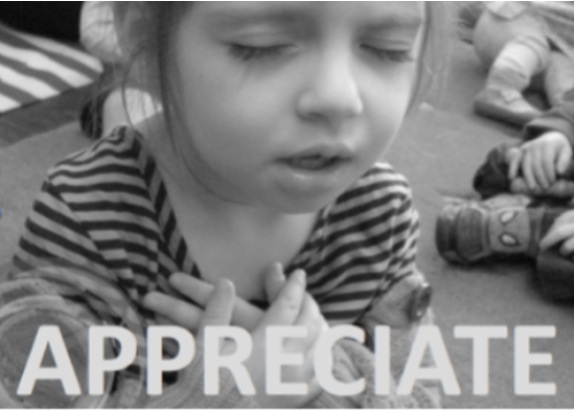
  1. Gratitude –   give thanks before you eat, not just for the food but for everything that allowed the meal to get to the table.  The farmer, the store, the truck that brought the food and the blessing of being in a country that has food in abundance. Get in the habit of pointing out your blessings, from the big things to the little things we all take for granted.  Children will learn what they see, and gratitude will help a child be more sensitive and appreciative.
  2. Practice wonder – a mindful contemplation.  Experiment with having a moment of silence and pay attention to how you are feeling.  Do this with your children.  Report to each other how it felt to be silent and what you were thinking and feeling.  You can do this before before bedtime, including breathing and stillness as a practice.
  3. Helping others – practicing kindness and giving are experiences that children can learn to model.  Volunteer as a family or just perform random acts of kindness, such as helping an older person open the door or take their groceries to the car for them.  It can open conversations for children that would not occur otherwise.
  4. Connect with nature – consider spending your evening with a contemplative walk outside and appreciating the stars.  Experience along with your child  a walk in the forest or a picnic at the beach. Take the time to look at the shore, the waves and the sky and point out details that might get overlooked. Consider the snowflakes as being unique and draw parallels to your unique child.  By having these conversations, you are exercising your child’s ‘spiritual muscle’ and are building more calm and resilient children as well enriching your self.
  5. Provide a spiritual role model – If you don’t feel like you can be a positive spiritual role model, try to find one for your child.  This will help your child connect outward and learn from others a more purposeful and positive outlook.

For more information on building spirituality in children, visit these websites:

www.Spiritualityforkids.com

http://www.livescience.com/3198-spirituality-religion-kids-happy.html