Parenthood: End of TV Show, But Real Parenthood Continues

For those of us who watched and loved the series of Parenthood, the final episode after six years was aired this week.  If you are a parent and haven’t tuned in to this show,  you will want to watch this show, available here.

http://www.nbc.com/parenthood

The show depicted so many realistic issues of family life, from autism to learning disabilities, to teen pregnancy, but most of all about a family who loves and laughs together.

I am reprinting this end post from Sheila Wagner, M.Ed, who wrote about the character of Max, the child with Autism Spectrum on the show. Here is an excerpt from her comments about the final episode after six seasons.

  Max and Parenthood have educated millions of viewers by introducing us to the gifts and idiosyncrasies of people with ASD, and gave us a glimpse of how it can fit into a solid family dynamic. It’s been easy to sit back and watch a fictional family from the comforts of our home, but there are thousands of real individuals in our schools and communities who need us to get involved.

Every year, 50,000 individuals with ASD transition from high school to adulthood, challenging existing adult services. Society will no longer be able to ignore them – and shouldn’t be allowed to. These folks need the help and support of community therapists and service providers, doctors, nurses and mental health agencies. Some need supported employment, help to connect them to others socially and, if they choose, options beyond living with their families. If we have learned anything from Max and Hank, it’s that making a difference in the lives of these individuals requires dedicated people who understand ASD and who offer understanding, help and support. Colleges and universities must address the increased critical need for trained professionals who can replace old hands who leave the field or retire. Autism is not going away. There is no miracle cure out there and research has yet to find the causes.

I need to believe that those watching Parenthood will be empowered to get involved and take action on behalf of these individuals. Their experiences are replicated thousands of times in our nation. People like Max and Hank are awaiting your efforts to enjoy their company, join them in activities, teach them new skills, embrace them as a new friend, hire them in your companies, and to spread the word about this amazing world of autism.

After blogging about Max for so many seasons and really getting to appreciate him, I also have to reaffirm my deep admiration for Hank. Max is succeeding, which I would expect from the early intervention he received. Hank is just now learning about himself. Although it’s stressful for him, he never gives up. He keeps fighting and learning more and more about himself and his disorder. We should all be like Hank – never giving up.

Saying goodbye to Max, Hank, the entire Braverman family and the Parenthood series is hard.  Losing the show will be a change for all of us, but life is a series of changes. For me, I’ll be retiring from my full-time job after 30-plus years in this field, but I will never stop helping those with autism. Once involved, always involved. I hope you’ll join me.

Sheila Wagner
Emory Autism Center
Emory University, Atlanta

Information on volunteer opportunities to help those with ASD is available here.


What is Brain Training and Can It Work?

Brain Training: Is it helpful for Atypical Kids?  Kristy Lea was searching for a way to 13300490_shelp her 5-year-old son improve his ADHD, and  she wanted to reserve medication as a last resort.  At the recommendation of her son’s occupational therapist, she decided to try a cognitive training program. “It was another avenue to try to help my son with focus and attention that didn’t involve medication,” says Lea, of New South Wales, Australia.  She promised her son a Star Wars Lego set if he completed the 5-week course.

It’s an expensive investment, but when you’re a parent of a child with additional needs, you’re willing to try something to see if it works,” she says.

Parents of atypical children are often most willing to try alternative treatments in the hope that something, anything, will help.  In the case of brain training games, fancy research claims, well developed websites and parent testimonials all tend to give hope to parents who are looking for the magic transformation.

Computer-based cognitive training programs — or brain-training games —  aim to improve working memory. That’s the part of short-term memory that allows you to hold onto information while using it. It lets you remember a phone number just long enough to dial it, while pushing out the distractions that would make you forget the number. Weak working memory is supposedly linked to some learning disabilities, and it can also be a part of ADHD. (But working memory is not a magic bullet to fix children with attention or learning problems and sitting on the computer extra hours of the day to the tune of thousands of dollars over many weeks is not substantiated by the research.)  

Increasingly, therapists, school systems, and parents are hoping that brain-training games will help children with learning challenges. K-12 school systems accounted for $195 million of revenue for the digital brain health industry in 2013. The K-12 segment of the industry is expected to grow by 20% per year, reaching $600 million in revenue by 2020, according to a report by SharpBrains, an independent market research firm that monitors the brain fitness market. About 40 of the 200 companies that SharpBrains follows market software for kids with learning disabilities.

Mixed Reviews

Those who purchase these types of brain-training games — which can cost from a few hundred to more than a thousand dollars — hope that improving working memory will make their child’s learning disabilities less severe. That’s what the game makers promise, but reviews are mixed.

“If you look at the [scientific research], the results are kind of all over the place. Some studies say they’ve found something significant, while other studies say they didn’t find anything,” says Michael P. Milham, MD, PhD. He’s the director of the Center for the Developing Brain at the Child Mind Institute in New York.

Results may vary greatly in part because the success of the programs can depend on the individual child. Some children respond to “brain training” while other kids really need to play outside or get an educational therapist to help with specific subject mastery.  

“You want to be careful. I’d judge it specifically by the case,” Milham says. “The thing with ADHD is if you give [kids] a task they can’t do, you could really discourage the child. If you have the wrong child doing this, you can wind up with some opposition or frustration. This may be well-suited [to some] but not necessarily everyone.”

Age, personality differences, and even biological differences could impact how much a person benefits from working memory training.

A review of about 25 different experiments concluded that children ages 10 and younger can improve verbal working memory — for example, the ability to remember and follow a series of spoken directions — with these games more than children ages 11 to 18 can. This review included studies of Cogmed, CogniFit, and Jungle Memory, as well as a few other unnamed programs.

Several studies have shown that those with the weakest working memory can benefit the most from brain training. Critics of working memory training argue that the skills kids sharpen with the games don’t extend widely into other aspects of life.

“What they’re learning is how to be good at the video games,” says Rita Eichenstein, PhD. She’s a pediatric neuropsychologist who specializes in assessing children with special needs. “Perhaps it exercises some very specific part of the memory system, but the goal of child development is an integrated approach to the demands of life, not just to become a computer whiz.”

Some Brain Gains Reported

Studies do confirm smaller short-term benefits, though. The large review of about 25 different experiments says that “the programs produced reliable short-term improvements in working memory skills.” Brain-training supporters say these gains should not be disregarded, as they may be transferred to academic skills.

‘Not a Magic Bullet’

Still, there’s not a consensus as to how long the improvements will last. And for all the studies that show benefits of these programs, there are others that show kids didn’t benefit much at all.

“While there might be some promise or potential, this just hasn’t been shown to a level of scientific rigor yet,” Milham says.

Some studies that show fewer benefits of brain training include children with multiple learning disabilities. Reputable brain training programs doesn’t recommend use of their product for children with multiple challenges, but that doesn’t mean that parents won’t insist on trying them.

Experts suggest that parents proceed with caution and manage their expectations.

“Learning disabilities are often lumped together when they advertise these programs, like, ‘We will cure dyslexia, ADHD, auditory processing.’ But you cannot capture all of these issues with one pill or computer program. There is no one single treatment that’s going to address all of those things,” Eichenstein says. Yet it’s common, she adds, for kids to have several learning challenges rather than just one.

Parents who want to try the games must motivate and closely watch the child, not just park him in front of the computer and expect him to complete the program.

“It was a tough few weeks on the program,” mother Kristy Lea says. But her son finished the course and earned his Star Wars Lego set.

“He was more able to maintain focus to read through an entire book and more interested in writing, and would choose to write notes now and then, which was something he hadn’t done previously,” Lea says.

But a little over a year later, “it’s very difficult to say if the changes were long lasting,” she says. 

To see the full article, go to: http://www.webmd.com/news/breaking-news/brain-training/20141211/brain-training-learning-disabilities

By Sonya Collins
WebMD Health News


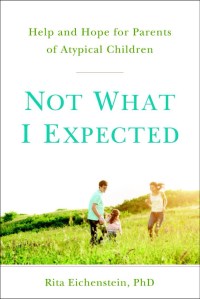
“Not What I Expected: Help and Hope for Parents of Atypical Children”

Not What I Expected: Hope and Help for Parents of Atypical Children  

IMG_3485 Now available on Amazon for pre-order!

Not What I Expected: Hope and Help for Parents of Atypical Children  

Dr. Rita Eichenstein has written a new book specifically for parents of atypical kids, supporting their emotional journey as they meet parenting challenges with increased awareness, optimism and emotional support.  With foreword by Daniel J. Siegel, M.D.

Pub date:  April 7, 2015 Perigee/Penguin Press

“A superb book. Chock full of arresting insights as well as warmth and wisdom.”—Edward Hallowell, M.D., author of The Childhood Roots of Adult Happiness

“In this magnificent handbook for learning to become the best source of support for an atypical child, Rita Eichenstein, Ph.D., serves as an inspiring guide. This book will walk you step by step through the inner and outer challenges of this journey.” –Daniel J. Siegel, M.D., author of Brainstorm and Mindsight 

 “At last, a book that speaks directly to parents of children who are atypical, as well as to their teachers. Easily digestible and offering insight, support, warmth, and a touch of humor, Not What I Expected will enhance your parenting toolbox and enrich your parenting life.”
Betsy Brown Braun, MA,  Child Development and Behavior Specialist, and bestselling author of Just Tell Me What to Say andYou’re Not the Boss of Me

“Clear, practical and filled with hope, the ideas and practices in this book offer a science-based common sense approach that any parent or practitioner working with an atypical child will be benefit from. What better gift can we give these children!”
Elisha Goldstein, PhD, author of Uncovering Happiness: Overcoming depression with Mindfulness and Self-Compassion  

 Pre-order your copy today: available on both paperback and kindle: 

Not What I Expected: Hope and Help for Parents of Atypical Children  

Not What I Expected: Hope and Help for Parents of Atypical Children  

The Gift of the Mismatch: When You and Your Kid Don’t Match

17337007_sSometimes, parents do experience a subtle type of disappointment with their child: when they and their child are mismatched, either by temperament, ability or by passion.

Why should this matter? While you are ready to love your child – no matter what! – there is a part of you that feels just a little rejected, powerless or dismissed when your child does not embrace what is important to you, or cannot be the type of person you want them to  be, perhaps because of a disability or just temperament.  In fact,  sometimes your child can be exactly opposite of what you expected!

Surfer Parents, Meet Sensory Sensitive Sam:

Take Betty and Bob. Passionate surfers, they had their first date on the beach. Their baby shower for their little boy featured little blue surfboards on top of every cupcake. But Sam was born with too much sensory sensitivity that he couldn’t handle the beach. He hated getting ‘dirty’, the noise of the ocean scared him and he hated the water. Disappointed parents could not help a child like Sam become his own person; Betty and Bob had some emotional work to do.

Surprise! Kids Aren’t Clones of Their Parents 

Kids are not necessarily clones of their parents. They come with their own kitbag of passions and aversions, let alone disabilities and handicaps. It’s not being selfish or narcissistic for parents to feel disappointed and powerless, stumped by an unexpected impasse that seems so unexpected that you are stopped in your tracks. It’s important to recognize it and learn how to handle these prickly sensitive feelings of yours.

Keep a Gratitude Diary:

If this is you, you just might want to try it.  It might sound trite, but the research is sound.  The potential benefits of expressing gratitude: increased immunity, lower blood pressure, less anxiety and depression, increased happiness.  Keeping that gratitude diary may also help you take some of the pressure off of your expectations of your child, as you build on your gratitude skills, your view of your child expands as you grow to appreciate the differences that enrich your lives.

There are many well known people with this complicated parenting wrinkle. Famously, Beverly Sills, the notable opera singer, had a deaf daughter as well as an autistic son. British model Katie Price has openly discussed the special needs of her son. She keeps a set of printed cards in her purse so when she encounters people staring at Harvey, who has septo-optic dysplasia (which causes blindness and growth hormone deficiency), Prader-Willi syndrome (a genetic disorder causing him to eat to excess and prone to obesity and diabetes) and ADHD and autism – she can simply hand a card to them, which reads, “You’re obviously looking because you’re interested. This is his condition… Look up what’s wrong with him and if you want to donate to a charity that supports children like this, then do it.”

Irish actor Colin Farrell, says his son James, who has special needs is “nothing but a gift.” “I don’t know if I would be here if I hadn’t had him,” the Total Recall actor said. He was a huge part of me going in and making certain changes in my life.” Colin’s son James was diagnosed with Angelman Syndrome, a neuro-genetic disorder that affects speech and movement, when he was a year old.

“I look around and I see people who move perfectly, who walk with grace, who speak with great diction and clarity and a great use of the English language and we’re all miserable f**kers – including me, at times,” Colin said. “And then I see this fella who doesn’t move the way what’s perceived to be ‘normal’ is, and he’s as happy as can be.”

 Clearly, while parenting is always a challenge, a most important and unexpected challenge is adjusting your expectations. When you adjust your expectations to embrace your child for who they are, rather than for whom you expect them to be, you can open your heart to allow for unexpected pleasure, and surprise gifts.

May this season of gratitude, sharing joy and gifts allow us all to appreciate the blessings of all children.


Four Things You Might Not Know about Learning Disabilities

29269571_sIt’s about that time of year when the parent-teacher conferences start the first round.  Parents, don’t wait for teachers to confirm things that you suspect about your child.  Your child’s teacher has only known your child for a few short months, now is the time to check things out if you are worried.


Here is the link to an article I collaborated on about learning disabilities from Scholastic Magazine, By Stephanie Booth.

The first step to overcoming any learning struggle — whether it’s been diagnosed or not — is to get informed. We spoke to parents and specialists to get the facts everyone needs to know.


1. Early warning signs can be missed.

Usually, there’s nothing you can do to prevent a learning disorder. That’s because many experts think these conditions are present before birth, thanks to genetics (LDs tend to run in families) or because a baby was exposed to toxins like lead while in the womb.

Clues can crop up in preschool, but they’re easy to overlook, since children learn at their own pace and go through many phases. Still, many kids with LDs have difficulty rhyming words; pronouncing new words; or remembering everyday routines, like how to zip a jacket.
Parents need to trust their instincts. After all, we know our children better than anyone else does,” she says. As soon as you suspect an issue, she adds, bring it up to the school and get your child tested. The earlier the learning disorder can be identified, the sooner a child can get help from the school or from an outside specialist.

2. LDs have nothing to do with being smart.

Kids with learning disorders get unfairly labeled as stupid or lazy, but many are super-smart. It’s just that their brains work differently — and that gets in the way of their ability to learn

For example, brain scans have shown that dyslexic kids mainly use the right side of their brains to read rather than the left, which is the part that controls language and analysis. When kids decode words, the information has to travel farther (from right to left) before it can be understood. That’s partly why dyslexic kids are slower readers. For many people with dyslexia, words can blend together — or the spaces between them can disappear. Some dyslexic kids can whiz through big words but struggle with little ones like “at” or “for.”
Brain differences can affect another type of LD known as auditory processing disorder (APD). A child with APD hears perfectly well, but she cannot accurately interpret the sounds she hears: “I picked an apple from the tree,” for instance, may sound like “I picked an ample frog tree.” Even the simplest instructions are difficult to decipher for these kids, especially when the classroom turns noisy.
3. LDs affect life in — and out of — the classroom.

A learning disorder doesn’t magically disappear when the last bell rings. Kids who spend all day struggling in school may act out at home. If they have trouble staying organized in class, the same is true when they get off the bus.

Besides dyslexia, Luke Reilly also has executive function disorder, so he struggles when he has to shift activities. To shore up these skills, Reilly gives her son a “to-do” list for the next morning that includes things most kids do automatically, including “put on your shoes.” She breaks down tasks for him step by step, has Luke repeat each step back before he does it, and reinforces the list with a chart. “The structure will eventually help Luke learn to do these things by himself,” explains his mom.
Still, it’s equally important to let kids figure stuff out on their own, particularly in areas they already shine in. “Luke is pretty intuitive and empathetic,” Reilly says. “I would never step in to help him in social situations the same way that I help manage his time and work.”
Reilly’s advice to parents: Have realistic expectations when dealing with the areas that a kid finds challenging. But set high expectations where kids show strengths and can stand on their own two feet. That’s another way to help boost self-confidence.
4. Kids with LDs have bright futures.
It’s normal for parents to feel anxious, angry, or crushed when their child gets diagnosed. The stats can be dire: 20 percent of kids with an LD drop out of high school, compared to 8 percent of other students, according to the U.S. Department of Education. Almost half of all high-schoolers with an LD have fallen three grade levels behind in math and reading.
But experts urge parents to reframe the situation. While learning differences can’t be cured, with the right tools, kids can excel and be successful, says Dr. Eichenstein. “Kids with learning disorders have the potential to change the world because of their creative, out-of-the-box thinking. The challenge is keeping their self-esteem strong and helping them find their unique talents.”
Parents can do that in all sorts of ways. First, it’s crucial to find the right type of help. To aid her 9-year-old with dyslexia, Dawn Clarke, of Gig Harbor, WA, located a learning center through the International Dyslexia Association (Interdys.org). Their son Jones goes three times a week after school — and he’s gotten the encouragement and specialized program he needs to read well.
Clarke also gives her son plenty of opportunities to pursue other passions that come more easily. “I tell Jones his dyslexia gives him the ability to think visually, and that’s why drawing’s a natural for him.”
“Jones’s difficulties have really become an asset,” Clarke continues. “He’s a problem-solver and go-getter, and that comes from having to work so hard at things most of us take for granted, like reading. There are advantages to not being an average learner. Look at Steve Jobs!”
Is it a Learning Disorder — or Trouble Learning?
Struggling to master a subject doesn’t necessarily mean there’s a neurologically based delay. Here, a few ways to tell the difference, from Rita Eichenstein, Ph.D., a pediatric neuropsychologist:
It’s probably not an LD if your child . . .
  • Used to do fine in school. Divorce, death, family problems, dealing with bullies, or getting used to a new school can all cause setbacks or cause a good student to suddenly fall behind.
  • Benefits from short-term help. Extra attention from the teacher or weekly meetings with a tutor can get many kids over the hump.
  • Is able to follow through on complex instructions. Even if kids forget a step now and then, they mostly know what to do when parents or teachers tell or show them.
It probably is a learning disorder if your child . . .
  • Has had trouble with classwork from day one. A kid with an LD struggles with key academic skills, from reading comprehension to figuring out math problems.
  • Can’t keep up with tutoring. These kids need frequent sessions with specialized teachers and effective methods to stay on track.
  • Can’t get through a set of instructions. Kids find it difficult to remember all the steps they need to follow directions.
When Your Child Needs Help
All public schools must evaluate kids for free. These tips can get you started on the right path:
Gather info
Make copies of your child’s report cards and tests, along with teacher comments and your observations.
Make a written request
State the reason your child needs to be evaluated in a letter or e-mail and send it to school officials.
Get de-briefed
A team of education pros will interview you and your child, observe her in the classroom, review her history, and administer tests. Afterward, they should explain the results and diagnosis to you.
Figure out the options
Kids diagnosed with an LD are entitled to an individualized education plan (IEP) that spells out special services (say, speech therapy) provided by the school free of charge. If your child doesn’t get an IEP, ask for a 504 plan, which gives kids with learning issues special accommodations, like extra time to finish tests.
Don’t give up
Every district has different requirements for IEP and 504 plans. If you disagree with the evaluation results or services, you have the right to another screening. You can also pay out of pocket for a third-party expert. To find one, go to Parentcenternetwork.org.

http://www.scholastic.com/parents/resources/article/disabilities-special-needs/4-things-you-might-not-know-about-learning-disabilities